
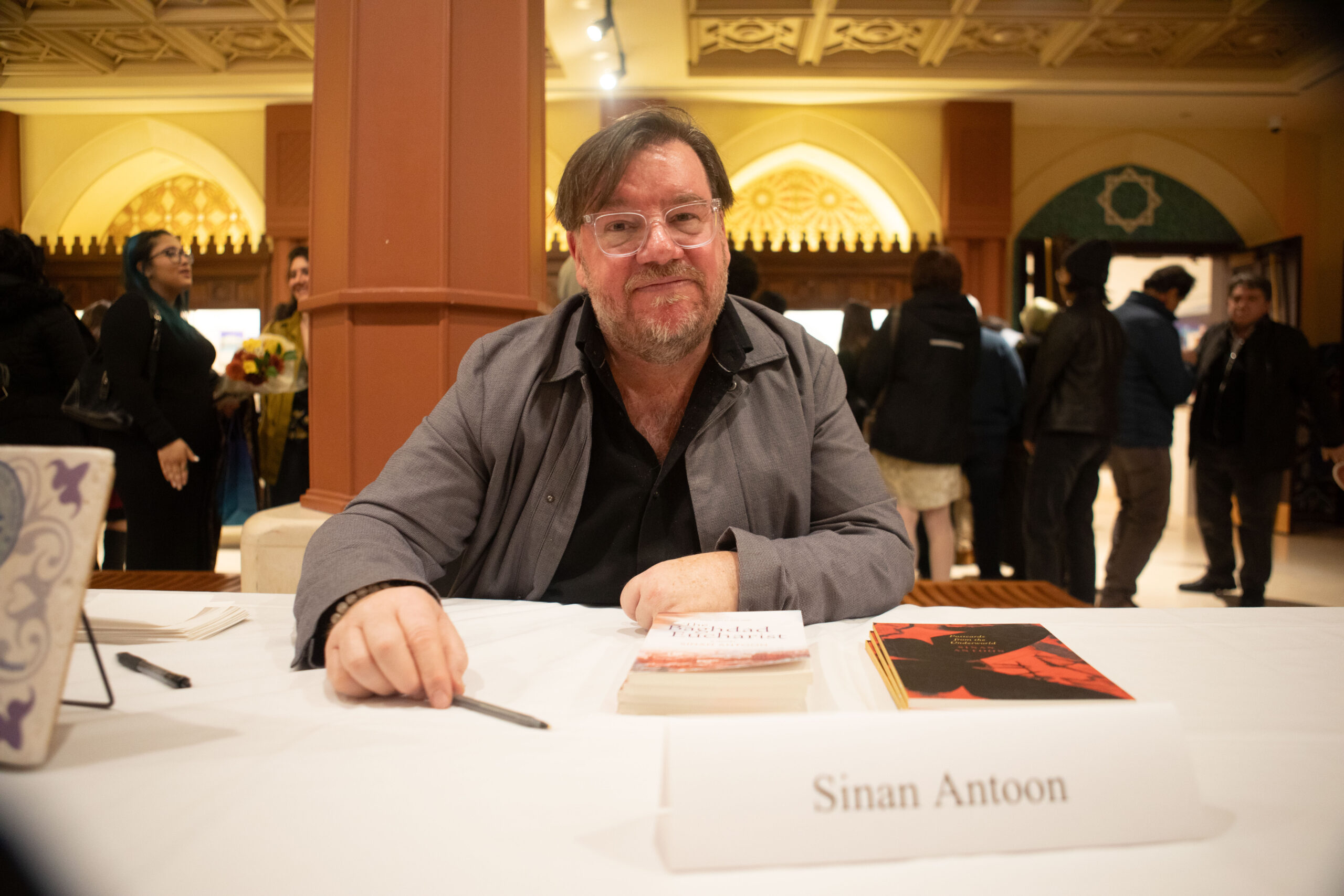
Recently, AANM sat down with Sinan Antoon — Iraqi poet, novelist, translator, scholar, and the 2025 AANM Lifetime Achievement Award honoree.
Antoon’s work has long explored the complexities of exile, language, and belonging, giving voice to stories shaped by war, displacement, and diaspora. In this conversation, he reflects on the craft of writing, the experience of living between languages and cultures, and the enduring question of what it means to call a place home.
Below are several key moments from the discussion.
1. You’ve been described as a poet, novelist, translator, and scholar. How do you define what you do?
Sinan Antoon: I usually say that I’m a wordsmith.
Sometimes I’m introduced as a scholar, and I say yes — but I’m also a writer. Other times I’m introduced as a writer, and I say yes — but I’m also a scholar. Wordsmith captures all of that.
At the end of the day, it’s about working with language. Writing, translating, researching — they’re all connected. And writing itself is labor. I like the idea of a writer as a craftsperson. You open your shop, sit down, and do the work.
2. Your life has moved between Iraq and the United States. How has that experience shaped your writing?
Sinan Antoon: For those of us who live in the diaspora, the question of home never really disappears.
I left Iraq in the early 1990s, and like many immigrants, I gained a lot by leaving. But I also lost something that cannot be retrieved. That tension never goes away.
Distance also changes how we remember places. Nostalgia can create an image of home that feels permanent and unchanging, but time transforms everything — especially a country that has experienced war and upheaval.
For me, writing becomes a way to grapple with that change. Literature allows us to recreate places, memories, and lives that may no longer exist the way they once did.
AANM Presents: Sinan Antoon
3. In the interview, you described home in a very poetic way. What does home mean to you today?
Sinan Antoon: Home is complicated.
There is the physical place — the city, the streets, the buildings. But there is also something else.
There is this constellation of songs, words, smells, scents, poems, and people that can suddenly be recreated even in the farthest place on earth.
You might hear a song, speak your language with someone, or share a meal — and in that moment, you feel at home again.
For many of us in diaspora, home exists in fragments like that. It’s not always a permanent state. It’s something that appears in moments.
4. You write across languages and genres. How do you decide whether something belongs in Arabic or English?
Sinan Antoon: Most of my poetry begins in Arabic. That language connects me to a long tradition of poets and to the literary world I grew up in.
My essays and scholarship, on the other hand, are often written in English because that’s the language of the academic world I work within.
But writing in Arabic is also emotional. When I first came to the United States in 1991, before the internet or satellite television, I suddenly found myself in a place where the language I spoke and dreamed in wasn’t present. Writing in Arabic was a way of returning to that language and reconnecting with it.
5. What advice would you give young Arab or Arab American writers today?
Sinan Antoon: Resist the pressure to write what others expect from you.
There are always institutional expectations — certain themes or stories people think writers from the Arab world should produce. My advice is to resist that.
Write what is truthful to the realities you know. Be critical of power. And don’t be seduced by temporary attention.
If you want to write something that lasts, it has to come from honesty — not from trying to fit into someone else’s expectations.
Sinan Antoon’s work continues to bridge languages, histories, and communities. Through poetry, fiction, and translation, he preserves stories shaped by exile and memory — while inviting readers everywhere to reflect on their own understanding of home.
Watch the full conversation with Sinan Antoon to hear more about writing, language, and life in diaspora.