
On March 26, 2026, the Arab American National Museum debuted Palestine: Grief & Connection Through Clay, an emotionally captivating exhibition featuring art from eight Palestinian ceramic artists including Leena Ismail, Car Nazzal, Eman Srouji, Leila Srouji, Amal Tamari, Pam Totah, Marina Wahbeh, and Karina Yanes.
The artists found community though their shared experiences of living in diaspora. They connected through social media for over two years before forming the collective, Pali Potters. Though the Pali Potters live in different locations across the US, their desire to preserve their rich heritage through ceramics unites them.
“Palestinians have experienced the divide and conquer tactic. We’ve been sprinkled throughout the world. This group show is a big deal. It shows that the divide and conquer tactic didn’t work. We’ve been able to come together through our art,” said Car Nazzal, a California-based ceramic sculptor and NCECA’s 2026 Multicultural Fellow.
At least 150 people attended the opening night for the exhibition, which included snacks, refreshments, and a meet and greet with the Pali Potters. The event was held in conjunction with National Council on Education for the Ceramic Arts’ (NCECA) 60th conference, Volumes, which took place in Detroit, Michigan, March 25-28.
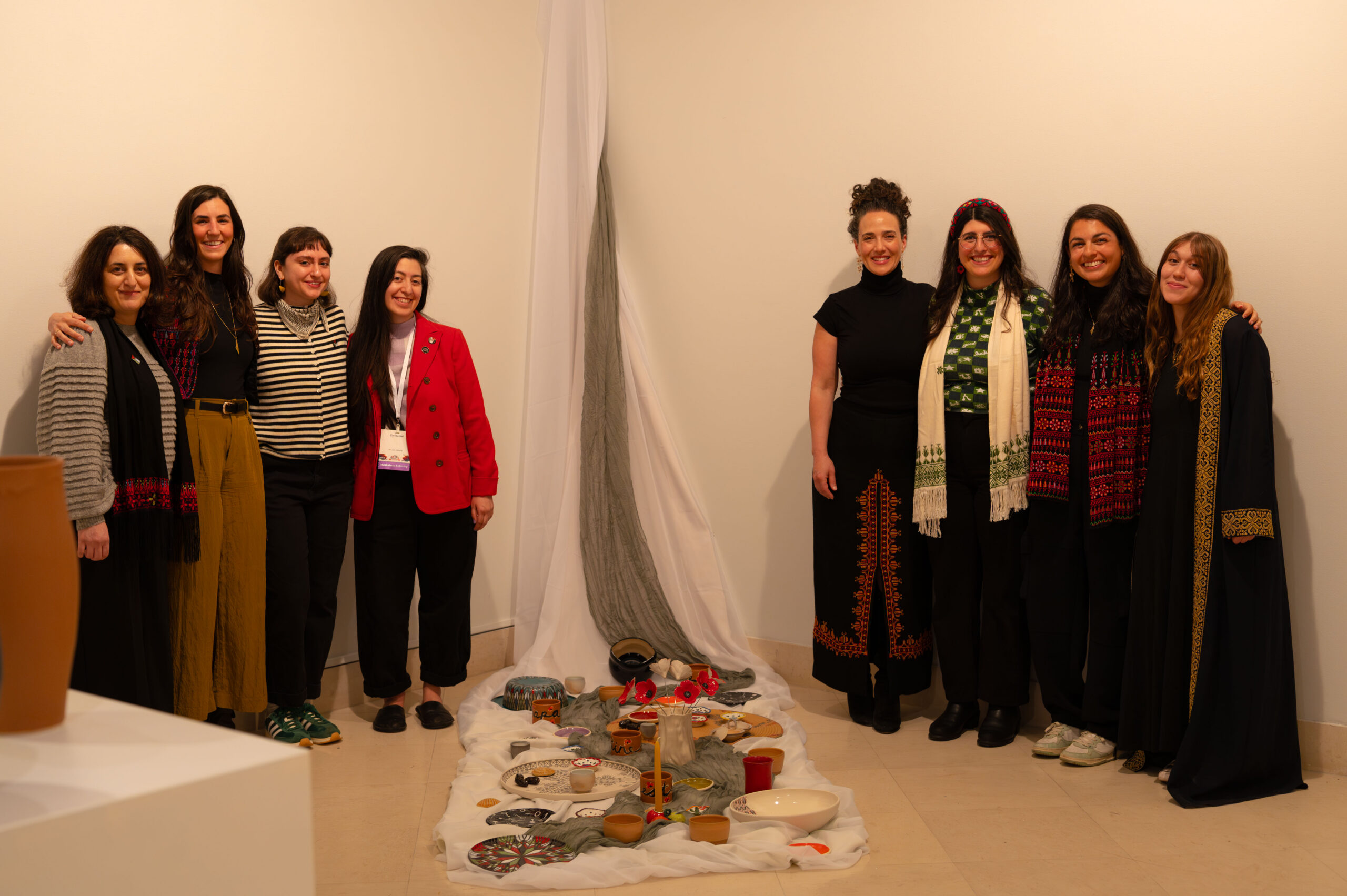
Members of the Pali Potters collective gathered at the opening of “Palestine: Grief & Connection Through Clay” at the Arab American National Museum.
The Pali Potters coordinated plans to meet each other for the first time in person and attend NCECA together. During planning, they also reached out to the museum looking for a place to show their work, which for Mark Mulder, NAAM exhibits curator, found to be a match made in heaven.
“I’ve heard repeatedly from Arab American artists that it’s really hard to get shows,” Mulder said. “They’ll go to shows and see their culture represented by non-Arab American artists. So, when the Pali Potters came to us with a proposal, it was a no brainer.”
An inspiring dining experience
One of the most memorable installations was Meet at the Table, which features a tablecloth that streams from the gallery’s ceiling and drapes down onto the floor. A piece of sheer fabric zigzags across the cloth, giving the display a watery effect that’s reminiscent of the well-known Palestinian liberation phrase, “from the river to the sea.” The intimate table setting includes ceramic dishware, red poppies, vases, and other functional yet intricately designed décor. A half-closed, purple eye sits at the head of the table, guarding the spread.
The Pali Potters specifically envisioned the table setting to be on the floor of the gallery. “We wanted to honor the traditional way of dining since sitting at the table is a very colonial invention,” said Leila Srouji, artist and owner of Tierra Madera Ceramics.
The table setting was inspired by a photograph of a table stretching over 100 feet and seating Gazan families during Ramadan. In the photograph, the table is surrounded by the rubble of destroyed homes and buildings. “They all gathered and had a meal, even in the war,” Srouji explained.
The group arranged the table setting in an organic way, going with how they felt. Building this piece together symbolized the same togetherness that inspired them to start a collective in the first place.
“It’s very cathartic… Srouji said. “Living in a country that is committing harm against our homeland brings up many complex feelings, but being together and not always having to speak about what it’s like is really touching. And it’s been wonderful to share our unique paths about how we got here.”
A soft place to lay your head
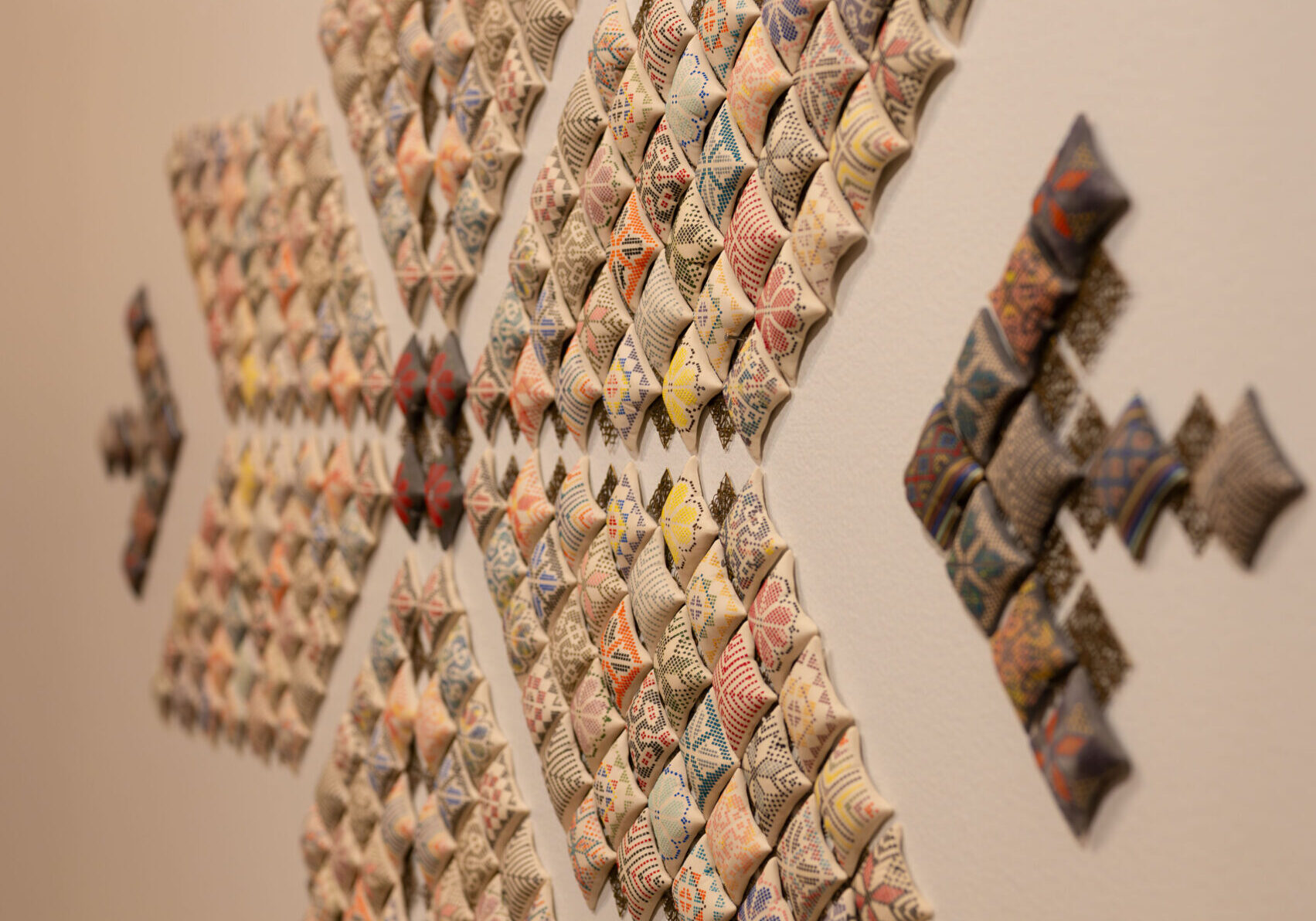
Pam Totah’s piece, The Register, features porcelain, underglaze, iron, and a mesmerizing display of over 300 miniature pillows covered in tatreez, or Palestinian embroidery. The artist assembled the piece at her mother’s breakfast table over two weeks and for 14 hours a day in her basement studio, often losing track of time.
Totah, who was inspired by her mother’s love of tatreez pillows and poet Mourid Barghout’s exile and journey home to Palestine, was searching for an activity that would help her take off her mind off the numerous attacks in Palestine and the Middle East, most recently in Iran.
“I'd be making pillows, and then I’d see the news, and I would just start crying. And I was like, oh, the world is ending…” Totah recalled. “This was a nice way to keep busy and distract myself.”
Citrus memories from the land of oranges
One of the most delicious pieces was most certainly Amal Tamari’s Jaffa Oranges, which features a barrel full of glistening ceramic oranges. If you look closely, you can see that each orange boasts its own set of Tamari’s fingerprints, adding to its uniqueness.
Tamari’s inspiration for the piece comes from her grandfather, Elias, whose family owned orange orchards in Jaffa. Jaffa was famous for its orange production before Israel seized, burned, and destroyed many of the orchards.
“It gives you a longing for this place that you don't get to go to,” Tamari said. “You feel sort of disconnected from the land and culture.”
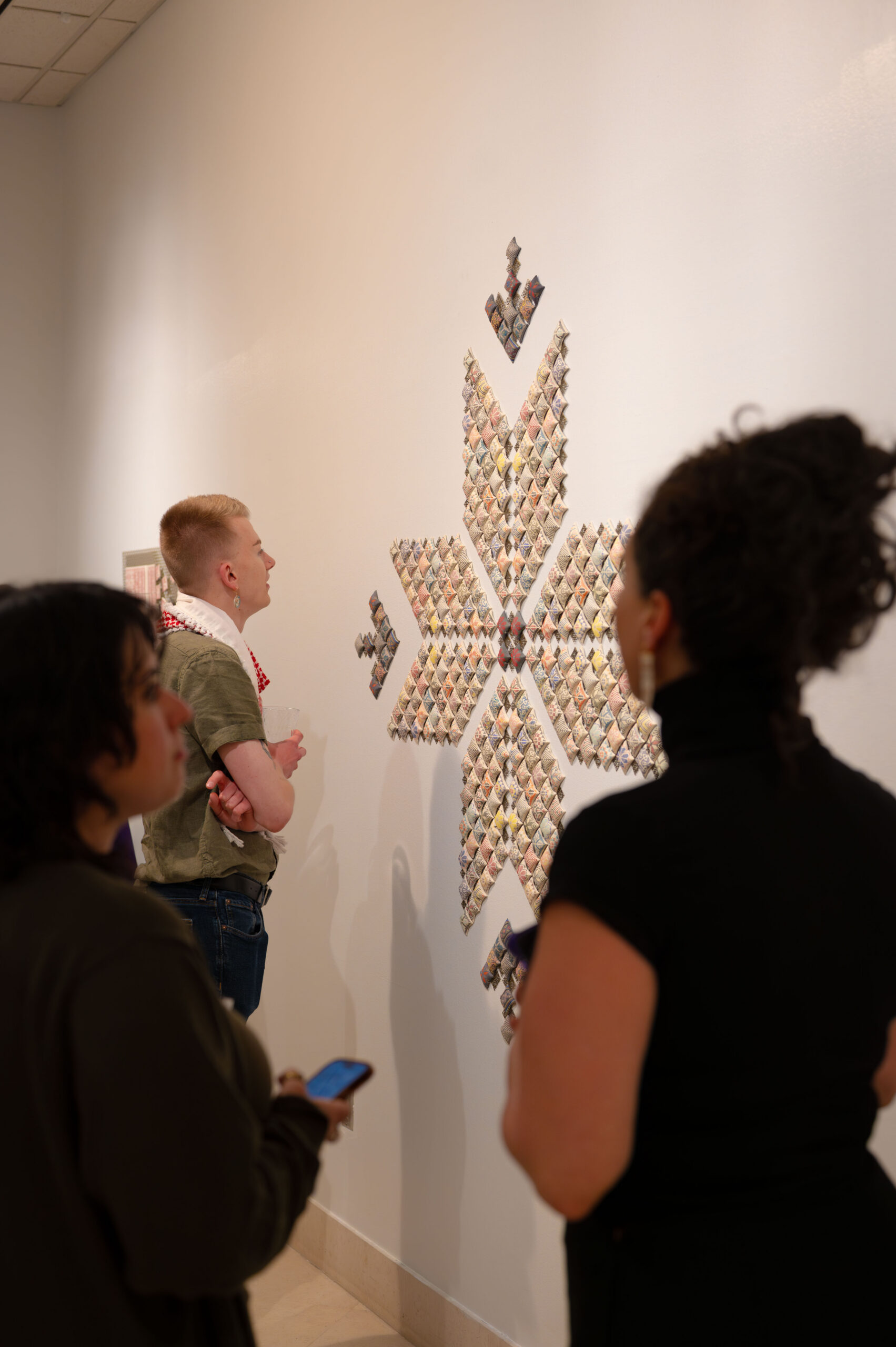
Visitors engage with ceramic works inspired by Palestinian tatreez patterns during the exhibition.
A poetic tribute to Palestinian resilience
Karina Yanes’ piece, Olive Branches Carried Us Home, offered a breathtaking conversation between two of Palestine’s most beloved symbols, the olive branch and the keffiyeh. The olive branches are arranged along the wall to give the effect of a flock of birds in flight, which adds a lightness to the heaviness of a charred keffiyeh.
“I wanted to capture the darkness that oftentimes comes with being Palestinian but also the hope and persistence,” Yanes said. “This seemingly charred keffiyeh is being lifted by these olive branches, which have turned into a flock of birds that are lifting the keffiyeh away in a hopeful way.”
Yanes worked with stoneware, underglaze, and Kevlar to create the piece. While she works, Yanes listens to a recording with stories about her grandparents’ lives in Palestine and creates what she hears. Her father left Palestine when he was only one year old and grew up in Syria. Eager to preserve his family’s stories, he gave his parents a recording device. The family now has access to these recordings, which are in Arabic and have been translated into a manuscript.
Yanes connects her art to her heritage in a graphic way versus literal, which to her gives her pieces more distance.
“A lot of my pieces include icons I continue to repeat. I like depicting removal from the original version of the thing, if that makes sense,” she explained. “For example, if you take a literal orange beyond the lived experience, it almost becomes like an emoji or icon.”
Yanes says this distance helps her understand her background in a way that makes sense to her as someone who represents a range of cultures including Palestinian, Puerto Rican, and Midwest American.
“I always felt like an imposter, like a less real version of the original thing,” Yanes said. “At home, I always felt we had this blended culture that I didn’t necessarily understand. And out in the world, I felt like I was never quite Puerto Rican, never Palestinian enough, and then I was also never white or Midwestern enough.”
Understanding grief through connection
There were several other pieces on display that struck a chord. Leena Ismail’s piece, Flying Home, features two small ceramic hands on pedestals reaching toward the ceiling where two kites hang from tight, invisible strings. The piece illustrates a childhood marked by occupation. She recalls her uncle teaching her and her siblings how to build and fly kites. While her childhood was a time of joy, it was also a time of curfews, school closures, violence, and fear.
Car Nazzal’s piece, Water, is a still life sculpture they modeled after the rubble and destruction of buildings and features a model filtration water system. It’s made from clay, glass, and metal. They also experimented with melted glass and bound objects. Though Nazzal’s primary medium is clay, they wanted to push themselves creatively and emotionally with this piece.
Nazzal was inspired by videos of Gazans teaching people how to filter water. “I thought it was super inspiring that someone in the middle of their genocide would take the time to show the world, ‘this is how we survive,’” Nazzal said.
Nazzal’s other piece on display was a sign with the words “Guilty of Genocide,” modeled after the sign Michigan Congresswoman Rashida Tlaib held up during Israel Prime Minister Benjamin Netanyahu’s address to Congress. Congresswoman Tlaib is the only Palestinian representation in American government. Nazzal found the Congresswoman’s act to be empowering and combative of censorship.
“She’s experienced censorship because there are people who don’t want Palestinian voices. I loved her creativity and spirit. She was like, ‘you can’t shut me down,’” Nazzal said.
Palestine: Grief & Connection Through Clay runs through May 31st at the National Arab American Museum. You won’t regret experiencing this memorable collection in person. For more information on the artists and to learn how you can support them, visit www.palipotters.com.